ASTRONOMY


Astronomy is a natural science that deals with the study of celestial objects (such as stars, planets, comets, nebulae, star clusters and galaxies) and phenomena that originate outside the Earth's atmosphere (such as the cosmic background radiation). It is concerned with the evolution, physics, chemistry, meteorology, and motion of celestial objects, as well as the formation and development of the universe.

Astronomy is an ever evolving and improving science. It is the oldest science in the world. Early cultures performed methodical observations of the night sky to decide when to plant and what the best day was for a celebration. The invention of the telescope propelled astronomy into a modern science, before that it was mostly theory and astrology combined. In modern times, the field of astronomy has split into observational and theoretical branches. Observational astronomy is focused on acquiring data from observations of celestial objects, which is then analyzed using basic principles of physics. Theoretical astronomy is oriented towards the development of computer or analytical models to describe astronomical objects and phenomena. The two fields complement each other, with theoretical astronomy seeking to explain the observational results,
and observations being used to confirm theoretical results.

Significant advances in astronomy came about with the introduction of new technology, including the spectroscope and photography. Fraunhofer discovered about 600 bands in the spectrum of the Sun in 1814–15, which, in 1859, Kirchhoff ascribed to the presence of different elements. Stars were proven to be similar to the Earth's own Sun, but with a wide range of temperatures, masses, and sizes.

Astronomy Chart


APPLES


Apple is the usually round, red or yellow, edible fruit of a small tree. The tree originated in Western Asia, where its wild ancestor, the Alma, is still found today. There are more than 7,500 known cultivars of apples, resulting in a range of desired characteristics. The apple tree was perhaps the earliest tree to be cultivated, and its fruits have been improved through selection over thousands of years.


Major Producers of Apples are China, United States, Iran, Turkey, Russia, Italy, India, France, Chile and Argentina. 2,500 varieties of apples are grown in the United States. Apples are grown commercially in 36 states. Apples are a great source of the fiber pectin. One apple has five grams of fiber. According to an estimate 55 million tones of apples are grown worldwide, with a value of about $10 billion. About two- fifths of this total is produced in China.


Apple is a rich source of flavonoid and polyphenols both are powerful antioxidant. It contains a large amount of minerals and vitamins that can strengthen the blood. It contains malic acid and tartaric acid that can help prevent disturbances of the liver and digestion. Apples have been recommended for : Obesity, Headache, Arthritis, Bronchial asthma, Inflammation of the bladder, Gonorrhea, Anemia, Tuberculosis, Neuritis, Insomnia, Catarrh, Gallbladder stones, Worms, Halithosis, Pyorrhea.

Apples

AGRICULTURE


Agriculture is the science or practice of farming, including cultivation of the soil for the growing of crops and the rearing of animals to provide food, wool, and other products. Agricultural science has focused on boosting production through the development of new technologies. It has achieved enormous yield gains as well as lower costs for large-scale farming. But this success has come at a high environmental cost.

The agricultural community has along supported new techniques that improve production and help make food even more affordable for consumers. For example, animals and crops have been selected for breeding for centuries resulting in improved disease resistance and bigger yields. Biotechnology simply gives the farmers the tools to speed up this process.


Today’s world is a place of uneven development, unsustainable use of natural resources, worsening impact of climate change, and continued poverty and malnutrition. Poor food quality and diets are partly responsible for the increase of chronic diseases like obesity and heart disease. Agriculture is closely linked to these concerns, including the loss of biodiversity, global warming and water availability.


Agriculture has contributed to climate change in many ways, for instance through the conversion of forests to farmland and the release of greenhouse gases. Conversely, climate change now threatens to irreversibly damage natural resources on which agriculture depends.

Agriculture Field


RAINBOW


Rainbow is a bow or arc of prismatic colors appearing in the heavens opposite the sun and caused by the refraction and reflection of the sun's rays in drops of rain. Rainbows can be observed whenever there are water drops in the air and sunlight shining from behind at a low altitude angle. The most spectacular rainbow displays happen when half the sky is still dark with raining clouds and the observer is at a spot with clear sky in the direction of the sun. Sun gives off light, which we see as 'white light'. But in fact, it isn't actually white at all, it is actually numerous different color wavelengths. The main colors it gives off are red, orange, yellow,
green, blue, indigo and violet. These colors are called the colors of the spectrum.

Rain don not necessarily need to have a rainbow. A rainbow can be formed in the mist of water droplets created by a waterfall. There is even a man who makes rainbows using water sprays on fire-fighting boats. There are five different kinds of Rainbows: 1-primary, 2-secondary 3-spurious or supernumerary bows, 4-fogbow, 5-lunar rainbow. Primary Rainbows can be watched all of the time. These are the normal red to violet arcs that we see after it rains. Secondary Rainbows are the rainbows that are reflected twice inside of
the rain drop. They have the colors reversed and appear next to the primary rainbow. Spurious
or Supernumerary bows are faint color arcs that sometimes seen next to the primary or secondary bow, due to interference. In this picture you can see the supernumerary as the blue hue underneath the bright primary rainbow. Fogbows or white rainbows are pale circles of light that are sometimes seen in clouds and fogbanks. Lunar Rainbows are formed when the moon emits white light that raindrops can refract and reflect into the atmosphere.

A Rainbow


MICROSCOPE


A microscope is an instrument used to see objects that are too small for the naked eye. The science of investigating small objects using such an instrument is called microscopy. Microscopic means invisible to the eye unless aided by a microscope.

The first microscope to be developed was the optical microscope, although the original inventor is not easy to identify. An early microscope was made in 1590 in Middelburg, Netherlands. Two eyeglass makers are variously given credit: Hans Lippershey (who developed an early telescope) and Hans Janssen. Giovanni Faber coined the name microscope for Galileo Galilei's compound microscope in 1625. Galileo had called it the "occhiolino" or "little eye".

The power of a microscope is generally displayed on the scope. If a microscope has a 60x written on it that means the images you see will be 60 times larger than they are in reality. A microscope that has only one eyepiece is known as monocular, while a microscope with two eyepieces is called binocular. Binocular are slightly more expensive but are considered simpler for a beginner to use.

Scientists can even use a microscope to figure out where illegal drugs come from. For example, looking at opium crystals through a microscope reveals different shapes depending on where the poppies they came from were grown. This information can help pinpoint the source of illegal drugs.

Microscope

MUSCLES

             Muscle is a tissue composed of cells or fibers, the contraction of which produces
movement in the body. There are three types of muscles:

1 - Smooth muscle - controlled by the autonomic nervous system; may either be generally inactive or then respond to neural stimulation or hormones or may be rhythmic.

2 - Cardiac muscle - found in the heart, acts like rhythmic smooth muscle, modulated by neural activity and hormones.

3 - Skeletal muscle - move us around and responsible for most of our behavior; most attached to bones at each end via tendons.

The muscle is composed of subunits called fascicles. Fascicles are bundles of individual muscle fibers. Each fiber is one elongated cell that may extend for the length of the muscle. Each muscle fiber cell has several nuclei (unlike most cells, which have only one), and is segmented into distinct sectional bands. Within each muscle cell are numerous myofibrils, which also extend for the length of the muscle cell. Sarcomeres are the basic contractile subunit of myofibrils.

Muscle growth is a specialized form of protein synthesis. As we saw above, a steroid hormone (testosterone) enters the muscle cell by diffusing directly across the cell membrane, combines with a receptor in the cell and then stimulates gene transcription and protein formation via the DNA -> mRNA -> tRNA -> protein pathway. Specific receptors and genes are involved.

Muscles In The Body

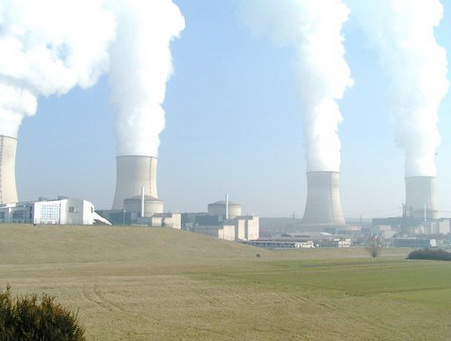
NUCLEAR POWER PLANT

                         A nuclear power plant (NPP) is a thermal power station in which the heat source is one or more nuclear reactors. As in a conventional thermal power station the heat is used to generate steam
which drives a steam turbine connected to a generator which produces electricity. Nuclear power
plants are base load stations, which are best suited to constant power output.
                        Electricity was generated for the first time ever by a nuclear reactor on December 20, 1951 at the EBR-I experimental station near Arco, Idaho in the United States. On June 27, 1954, the world's first nuclear power plant to generate electricity for a power grid started operations at Obninsk,
                        There are 104 commercial nuclear power plants producing 20 percent of all electricity and over 70 percent of the emission-free electricity generated in the United States. They are located at
64 sites in 31 states. More than 400 nuclear power plants worldwide produce 16 percent of the world’s electricity—while reducing CO2 emissions by more than 2 billion metric tons per year. Nuclear energy supplies electricity each year to serve 60 million homes.
                        Nuclear energy has one of the lowest environmental impacts of any electricity source. For
example, a wind farm would need 235 square miles to produce the same amount of electricity
as a 1,000-megawatt nuclear power plant. Nuclear energy is by far the nation’s largest source of electricity that does not emit any controlled air pollutants, providing 73 percent of the electricity from all carbon-free sources, including hydroelectric, wind and solar. Nuclear power plants provide low-cost, predictable power at stable prices and are essential in maintaining the reliability of the U.S. electric power system.
                        There are nearly 100 different nuclear medicine imaging procedures available today. An
estimated 10 to 12 million nuclear medicine imaging and therapeutic procedures are performed each year in the United States.

A Nuclear Power Plant

CHOCOLATE

                    Chocolate history starts out in Latin America, where cacao trees grow wild. The first people to
use chocolate were probably the Olmec of what is today southeast Mexico. They lived in the area around 1000 BC, and their word, "kakawa," gave us our word "cacao."
                     For humans though, Chocolate is a wonderful energy source. Napoleon supposedly carried along Chocolate on his military campaigns, and always ate it to restore energy. Nowadays Sports- persons are often given Chocolate energy bars after sporting activities to restore carbohydrates.
                    Chocolate also contains high amounts amino acids from which the body builds protein and also
dopamine (which scientists believe stimulates the brain’s pleasure receptors) and adrenaline.
                    The bottom line is that indulging in a small amount of dark chocolate might be the perfect
dessert - satisfying your sweet tooth while treating your body to the many health benefits of chocolate. So next time you're craving dessert, reach for the dark chocolate, and hold the guilt.

Chocolates


LIGHTNING

              Lightning is a brilliant electric spark discharge in the atmosphere, occurring within a thundercloud, between clouds, or between a cloud and the ground. This enormous electrical discharge is caused by an imbalance between positive and negative charges. During a storm, colliding particles of rain, ice, or snow increase this imbalance and often negatively charge the lower reaches of storm clouds. Objects on the ground, like steeples, trees, and the Earth itself, become positively charged—creating an imbalance that nature seeks to remedy by passing current between the two charges.
             Some scientists think that Lightening may have played a part in the evolution of living organisms. The immense heat and other energy given off during a stroke have been found to convert elements into compounds that are found in organisms.
             It's true that being inside a building when lightening strikes is your safest bet, but that doesn't mean you shouldn't take some precautions. If a building gets struck the electrical current will most likely travel through the wiring or plumbing before going into the ground. That's why you should stay off of corded phones (cellular and cordless are okay) and away from running water (so no showers or hand- or dish-washing). Don't use stoves, computers, or anything else that's connected to electricity

Lightning

LAKES

                    Lake is a body of fresh or salt water of considerable size, surrounded by land. Lakes generally
form in depressions, such as those created by glacial or volcanic action; they may also form when a section of a river becomes dammed or when a channel is isolated by a change in a river's course. The most lakes are of fresh water, and most lie in the Northern Hemisphere at higher latitudes. More than 60 percent of the world's lakes are in Canada and this is because of the deranged drainage system that dominates the country.
                    Lakes were formed many thousands of years ago by glaciers. At that time, huge glaciers covered the earth. When the glaciers melted, some of the water that was over hollows in the earth became
lakes. Other ways lakes were formed include manmade lakes, natural dams and craters formed in great volcanic explosions. Lakes get bigger and smaller, depending on many factors. Lakes get smaller if they get filled up with silt or other material. They also dry up if they are not replenished with water through rainfall. Other lakes get deeper and bigger as rivers, rainfall and underground water make the lake expand.
                    Lakes can be also categorized on the basis of their richness in nutrients, which typically affect
plant growth. Nutrient-poor lakes are said to be oligotrophic and are generally clear, having a low concentration of plant life. Mesotrophic lakes have good clarity and an average level of nutrients. Eutrophic lakes are enriched with nutrients, resulting in good plant growth and possible algal blooms. Hypertrophic lakes are bodies of water that have been excessively enriched with nutrients. These lakes typically have poor clarity and are subject to devastating algal blooms.
Lake Baikal

LANDSLIDES

             Landslide is the downward falling or sliding of a mass of soil, detritus, or rock on or from a steep slope. Many kinds of events can trigger a landslide, such as the over steepening of slopes by erosion associated with rivers, glaciers, or ocean waves; heavy snowmelt which saturates soil and rock; or earthquakes that lead to the failure of weak slopes.
             Gravity is the ultimate force behind any landslide and that weathering plays a part. Land surfaces are held together by multiple forces. The most important of these is friction. Some soil particles, like clay, cling to each other tightly, while others, like sand, are only loosely joined. All landscapes are held together by friction between the sediment cover and the underlying bedrock, some more tightly than others. If something is introduced to disrupt the friction on an incline, a landslide slips into action. Landslides occur when gravity overcomes the force of friction. If the Earth's crust vibrates enough to disrupt the force of friction holding sediments in place on an incline, a landslide can strike.
              Stay away from the landslide area as there may be danger of additional slides. Do not drive through. Do not build on or at the base of unstable slopes, on or at the base of minor drainage hollows, at the base or on top of an old fill slope, at the base or top of a steep cut slope. Make an evacuation plan in case of a landslide with all the emergency items.

A Landslide


GOLF BALL

                        Golf ball is a small, white ball with a tough cover and a resilient core of rubber, used in playing golf. In the earliest days of golf on the eastern coast of Scotland, players used primitive equipment to play the game in a rather haphazard and casual manner. The first clubs and balls specifically made for golf were fashioned from wood. One documented reference is that of a John Daly playing with a wooden ball in 1550.
                        Golf balls had quite irregular weights. While the feathery balls were less standardized the
weights were becoming standardized with the beginning of the gutta percha balls. Nowadays, golf balls are ranking between 41-47 grams, including those being produced still in the 70ies. The average weight would be around 45gr. One exception is the Cayman ball, constructed by Jack Nicklaus in the 80ies. This ball only weights half of the standard weight (approx. 20 gr.) to enable less distance for smaller golf courses.
                         When a golf ball is hit, the impact, which lasts less than a millisecond, determines the ball’s velocity, launch angle and spin rate, all of which influence its trajectory (and its behavior when it hits the ground). To keep the aerodynamics optimal, the golf ball needs to be clean, in order to avoid any impediments to the aerodynamic effect of the ball. Thus, it is advisable that golfers frequently wash balls. Golfers can wash balls manually, but mechanical ball washers are also available.

Golf Ball


GIRAFFE

                   Giraffe is a tall, long-necked, spotted ruminant, the tallest living quadruped animal. The giraffe
is related to other even-toed ungulates, such as deer and cattle, but is placed in a separate family. The average weight of a giraffe (male) is 1,200 kilograms, while the weight of a giraffe (female) is 830 kilograms. It is approximately 4.3 meters (14 ft) to 5.2 meters (17 ft) tall. The average lifespan of a giraffe is 25. This increases to 28 for giraffes in captivity.
                   Giraffes live in only one continent- Africa. They are found between the countries of Central
Africa and South Africa. They live in savannas, grassland or open woodland. They enjoy roaming through both dense forests and open plains. They prefer living in areas with lots of acacia trees which is their favorite food. It eats up to 75 pounds of food a day. Its tongue is 18 inches long. Their heart is 2 feet long and weighs about 25 pounds. They spend between 16 and 20 hours a day feeding. Giraffes in the wild generally stand up to sleep, because it would take too long for them to get back on their feet should a predator approach.
                   Giraffe gestation lasts between 400 and 460 days, after which a single calf is normally born,
although twins occasionally occur. The mother gives birth standing up and the embryonic sack usually bursts when the baby falls to the ground. Newborn giraffes are about 1.8 meters tall.

A Giraffe


GALAXY

                          Galaxies are groups of billions of stars that are held together by the force of gravity. Most
galaxies are either spiral or elliptical, but some are irregular in shape. The best known galaxy is the Milky Way. The word galaxy itself comes from the Greek word of Milk. This is because before telescopes were powerful enough to prove that they were made up of individual stars, galaxies looked like milky or cloudy areas in the sky. Our relatively small solar system is only one of 100-200 billion stars in the Milky Way Galaxy, which is 100,000 light years in diameter. The sun and all the planets take about 200,000,000 years to complete one orbit around its center. The large Magellanic Cloud, which is visible only in the southern
hemisphere, is 170,000 light years from Earth and 39,000 light years in diameter. The central galaxy of the Abell 2029 galaxy cluster was discovered in 1990. It is 1,070 million light years distant and has a diameter of 5.6 million light years, 80 times the diameter of our own galaxy.
                            A typical spiral galaxy is shaped like a flat disk, about 100,000 light-years in diameter, with a central bulge, or nucleus, containing old stars; winding through the disk are the characteristic spiral arms of dust, gas, and young stars (see stellar populations). This type of galaxy is further classified as being either a normal or a barred spiral. In the normal spiral, the arms, at least two in number, join smoothly with the nucleus; in the barred spiral, the arms project from a bank of stars that runs through the nucleus. The elliptical galaxies, lacking spiral arms entirely and containing little or no gas and dust, resemble the nuclei of spiral
galaxies. Their shapes vary from nearly spherical to highly flattened ellipsoids. Elliptical galaxies have a much greater variation in size, mass, and luminosity than do spiral galaxies; their sizes range from the largest known
galaxies of all, with luminosities about 10 times that of the Andromeda Galaxy, to the small dwarf elliptical, which can contain as few as a million stars. Irregular galaxies appear structure less and without any nucleus or rotational symmetry; their light comes mostly from young stars.

Our Galaxy


GLACIERS

                       Glacier is an extended mass of ice formed from snow falling and accumulating over the years
and moving very slowly, either descending from high mountains, or moving outward from centers of accumulation. Glaciers exist in high mountains throughout the temperate zones and cover most of Antarctica. Glaciers recede during warm periods and can expand during cold periods. A significant percentage of the water of the Earth is locked up in glaciers.
                         Today, glaciers contain nearly 75% of the world’s fresh water supply in ice that covers about
10% of land area. In contrast, ice covered as much as 30% of total land area during the most recent ice age. The largest concentration of ice today is the Antarctic ice sheet, up to 4,200 meters thick in some areas, and in the Greenland ice sheet. The remainder of glaciers is located in mountain regions and in ice caps in polar seas. If climate were to suddenly warm enough to melt all land ice, there would be a ecstatic sea level rise of about 70 meters. Sea level has risen about 100 meters since the last glacial maximum 20,000 years ago.
                           There are seven main ways that humans use glaciers (or their landscapes), these are: Tourism, Energy Production, Water Supply, Quarrying, Agriculture, Transport / Communication, Settlement.

Glaciers

DIAMONDS

                     Diamond is a pure or nearly pure, extremely hard form of carbon, naturally crystallized in the
isometric system. Diamonds can be identified by their high thermal conductivity. Diamond is less stable than graphite, but the conversion rate from diamond to graphite is negligible at ambient conditions. Diamond is renowned as a material with superlative physical qualities, most of which originate from the strong covalent bonding between its atoms.
                     The first recorded history of the diamond dates back some 3,000 years to India, where it is
likely that diamonds were first valued for their ability to refract light. In those days, the diamond was used in two ways-for decorative purposes, and as a talisman to ward off evil or provide protection in battle.
                     Diamonds are an ideal of mechanical parts that resist wear and undergo a sudden temperature
changes and that not change size, create friction or rust. Diamond bearing are used in instruments for laboratories. No friction is created when rubbing them together because of their hardness. Some machines turn at 90 000 revolutions a minute. No lubrications are needed even at this high speed to keep the bearing from wearing away. Diamond cutting tools cut much faster and accurately than other tools. Metals can be sliced thinner than human hair by the diamond blade.
                      A large trade in gem-grade diamonds exists. Unlike other commodities, such as most precious
metals, there is a substantial mark-up in the retail sale of gem diamonds. There is a well- established market for resale of polished diamonds (e.g. pawn broking, auctions, second-hand jewelry stores, diamantaires, bourses, etc.). One hallmark of the trade in gem-quality diamonds is its remarkable concentration: wholesale trade and diamond cutting is limited to just a few locations; in 2003, 92% of the world's diamonds were cut and polished in Surat, India. Other important centers of diamond cutting and trading are the Antwerp diamond district in Belgium, where the International Gemological Institute is based, London, the Diamond District in New York City, Tel Aviv, and Amsterdam.


A Diamond
                   A digital camera is a camera that takes video or still photographs, or both, digitally by
recording images via an electronic image sensor. It is the main device used in the field of digital photography...Once a picture has been taken, it can be downloaded to a computer system, and
then manipulated with a graphics program and printed. Unlike film photographs, which have an
almost infinite resolution, digital photos are limited by the amount of memory in the camera, the
optical resolution of the digitizing mechanism, and, finally, by the resolution of the final output device.
                 The big advantage of digital cameras is that making photos is both inexpensive and fast because
there is no film processing. Interestingly, one of the biggest boosters of digital photography is
Kodak, the largest producer of film. Kodak developed the Kodak Photo CD format, which has become the de facto standard for storing digital photographs.
                  Digital cameras can offer well to excellent image resolution. You get superior image quality.
You get a fair price. A digital camera is reasonably priced and is affordable. You can print in large sizes. Due to its high resolution, pictures can be printed in large sizes by any plotter. You can store the images in CDs or hard disk. Once the pictures are transferred from digital camera to the computer, permanent storage on a CD or hard disk is possible. You can take the camera in your pocket while you travel. The small size of the digital camera makes traveling with it easy and a pleasure.

A Digital Camera

EXPLOSIVES

                  Explosive, is a reactive substance that contains a great amount of potential energy that
can produce an explosion if released suddenly, usually accompanied by the production of light,
heat, sound, and pressure. An explosive charge is a measured quantity of explosive material.
                 In considering the use of high explosives for destructive purposes, the first requirement is
to using the most effective explosive available. This will govern the selection for the buster with
maximum effect by an acceptable safe means. This will usually mean using the smallest possible
amount of suitable primary explosives. The basic high explosive train consists of the detonator,
booster, and bursting charge. However, high explosive charges are loaded into their containers
by one of three methods-cast-loaded, pre-loaded, or extrusion. Cast loading is preferred by
pouring the substance as a liquid into a container and letting it solidify.
                  Explosives are of immense value in many peaceful pursuits—in mining, quarrying, and
engineering enterprises and in making fireworks, signal lights, and rockets. They are used to project lifelines to ships in distress off storm-beaten shores or to the roofs of burning buildings; to cast oil upon rough seas; and to break up ice jams.

Explosives


EYES

                  Eyes are one of the most important channels we use to gather information and make
sense of the world around us. We also use our eyes to express how we feel knowingly or
unwittingly in a way that is often more powerful than spoken words.
Eyes are the organ of sight, in vertebrates typically one of a pair of spherical bodies contained
in an orbit of the skull and in humans appearing externally as a dense, white, curved membrane, or
sclera, surrounding a circular, colored portion, or iris, that is covered by a clear, curved
membrane, or cornea, and in the center of which is an opening, or pupil, through which light
passes to the retina. The human eye is one of nature's wonders and functions like a photo
camera. Only that is much more complex.
                  Eyes are composed of more than 2 million parts. According to an observation the average
person blink his eyes 12 times in a minute. The eyeball of a human weighs approximately 28
grams. By the age of 7 years old our eyes are fully developed and are physiologically the same
as adult’s eyes. The space between your eyebrows is called the Glabella. Eyes contribute towards
85% of your total knowledge.
                  Carrots, loaded with beta carotene are especially helpful in maintaining healthy eyes.
Goggles or something other should be wear to protect eyes while working with chemicals or any
place with harmful airborne particulates.

Eyes


BRAIN

                      The brain is a part of the body that allows us to make sense of the world around us and
to change our behavior to respond to it. Our brain is the control center of the whole body. It receives messages from all parts of our body and sends out necessary commands to control the body's actions. The brain is made up of a special type of cells. They are connected with each other and with the nerves in our body. The delicate brain is protected on the outside by strong skull bones. The brain is made of three main parts: the forebrain, midbrain, and hindbrain. The forebrain consists of the cerebrum, thalamus, and hypothalamus (part of the limbic system). The midbrain consists of the tectum and tegmentum. The hindbrain is made of the cerebellum, pons and medulla. Often the midbrain, pons, and medulla are referred to together as the brainstem.
                         Brain uses approximately 20% of the total oxygen pumping around the body…and about
750ml of blood pumps through the brain every minute. Information travels at different speeds within different types of neurons. Transmission can be as slow as 0.5 meters/sec or as fast as 120 meters/sec. 80% of the brain is water. Living brain tissue is a squishy, pink and jellylike organ.

The Human Brain